Is $60,000 a Good Salary in 2026? Take-Home Pay and Cost of Living by State
A $60,000 salary is a little below the median for full-time workers in the USA and above the median for all workers. Here is what it means after federal taxes, how far it goes in different states, and how $58,000, $66,000 and $78,000 compare.
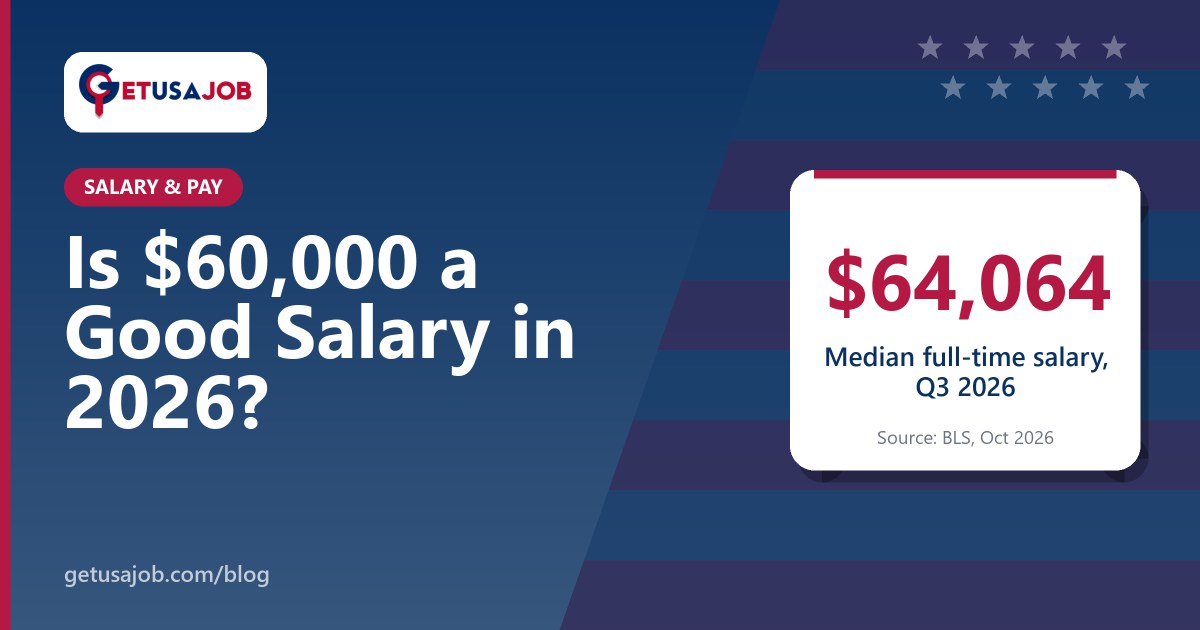
Table of contents
Short answer: is $60,000 a good salary? For a single person in most of the USA, yes. It is just below the typical full-time salary, which was about $64,064 a year in the third quarter of 2026 (BLS), and well above the median for all workers including part-timers. After 2026 federal taxes, a single filer keeps about $50,390 a year, or $4,199 a month, before state tax. It is comfortable in low-cost states, tight in the most expensive cities, and thin for a family on one income.
Last reviewed: November 24, 2026. Figures use the latest BLS earnings data and the IRS tax brackets for 2026.
Key takeaways
- $60,000 is $1,154 a week or $28.85 an hour for a 40-hour week, a little under the full-time median of $1,232 a week.
- It is about what a typical full-time worker aged 25 to 34 earns: $60,996 a year at the median.
- For a single adult, it is above the MIT living wage in 46 states, just short of it in California, Hawaii, Massachusetts and New York, and below what SmartAsset calculates is needed to live "comfortably" in every state.
- Nine states do not tax wages, so $60,000 goes further in Texas, Florida or Washington than in a state with income tax.
How does $60,000 compare with what Americans earn?
The Bureau of Labor Statistics Usual Weekly Earnings report for Q3 2026 shows where full-time pay falls. The median, the middle full-time worker, earned $1,232 a week. A quarter of full-time workers earned less than $849 a week (about $44,148 a year) and a quarter earned more than $1,908 (about $99,216).
That puts $60,000 in the middle of the pack: higher than at least a quarter of full-time workers, a little below the halfway mark. If you count everyone with a job, including part-timers, $60,000 looks better. The BLS occupational survey puts the median for all workers at $50,980 a year (May 2025).
Age makes a big difference. The median full-time worker aged 25 to 34 earned about $60,996 a year in Q3 2026, and workers aged 16 to 24 about $40,196. So $60,000 at 26 is roughly typical, while at 45, when the median is about $73,164, it is below average. Our main guide to what counts as a good salary in the USA has the full tables by age and education.
How much is $60,000 a year after taxes?
For a single filer taking the 2026 standard deduction of $16,100, with no other income and no pre-tax deductions, the federal picture looks like this:
| Item | Per year | Per month |
|---|---|---|
| Gross salary | $60,000 | $5,000 |
| Federal income tax | $5,020 | $418 |
| Social Security (6.2%) | $3,720 | $310 |
| Medicare (1.45%) | $870 | $73 |
| Take-home before state tax | $50,390 | $4,199 |
Calculated from the IRS 2026 tax brackets (10% up to $12,400 of taxable income, 12% up to $50,400) and the employee Social Security and Medicare rates. Your paycheck will be lower if you pay into a 401(k), health insurance or other benefits.
Paid every two weeks, that is about $1,938 per paycheck before state tax. State income tax then takes a further amount that depends on where you live. Alaska, Florida, Nevada, New Hampshire, South Dakota, Tennessee, Texas, Washington and Wyoming do not tax wages (see the Tax Foundation's 2026 state rates).
Is $60,000 enough to live on in my state?
The MIT Living Wage Calculator estimates what a full-time worker needs to cover basic costs such as housing, food, transport, health care and taxes, with nothing left for extras. SmartAsset's 2026 study doubles MIT's figure for a single adult, using the 50/30/20 budget rule, to estimate what it takes to live "comfortably", with room for wants and savings.
| State | MIT living wage, single adult | SmartAsset "comfortable" | $60,000 is... |
|---|---|---|---|
| West Virginia | about $40,600 | $81,245 | Well above the living wage |
| Ohio | about $43,700 | $87,360 | Well above the living wage |
| Texas | about $45,300 | $90,563 | Well above, with no state income tax |
| Florida | about $50,100 | $100,214 | Above, with no state income tax |
| Georgia | about $50,400 | $100,714 | Above the living wage |
| Illinois | about $50,800 | $101,587 | Above the living wage |
| New York | about $62,200 | $124,342 | Just below the living wage |
| California | about $63,400 | $126,797 | Just below the living wage |
| Hawaii | about $64,500 | $129,002 | Below the living wage |
Sources: SmartAsset, "salary it takes to live comfortably in each US state in 2026", based on MIT Living Wage Calculator data (updated February 2026). The MIT column is half of SmartAsset's figure, which matches MIT's published hourly rates (for example $24.21 an hour in Georgia and $31.01 in Hawaii, times 2,080 hours). Costs inside a state vary a lot between cities and rural areas.
The pattern is clear. In most of the South and Midwest, $60,000 covers a single person's basics with real money left over. In New York, California, Massachusetts (about $63,600) and Hawaii, it falls just short of the state's living wage, and in cities such as New York City, San Francisco or Honolulu it is tight.
Is $60,000 a good salary for a family?
It is harder. Costs rise quickly with children, mainly because of childcare, and SmartAsset finds that two working adults with two children need at least $200,000 a year to live comfortably in 40 states. A $60,000 single income can support a family in low-cost areas with careful budgeting, but in most places it works best as one of two incomes.
Is $58,000, $66,000 or $78,000 a good salary?
People often compare offers a few thousand dollars apart. This table puts common salaries side by side, using the same single-filer federal calculation as above.
| Salary | Hourly (40 h) | Monthly take-home* | Compared with full-time workers |
|---|---|---|---|
| $57,000 | $27.40 | $3,998 | Below the median, above the bottom quarter |
| $58,000 | $27.88 | $4,065 | Below the median, above the bottom quarter |
| $60,000 | $28.85 | $4,199 | Just below the median |
| $64,000 | $30.77 | $4,467 | About the median |
| $66,000 | $31.73 | $4,601 | Just above the median |
| $69,000 | $33.17 | $4,781 | Above the median |
| $73,000 | $35.10 | $5,015 | Above the median |
| $78,000 | $37.50 | $5,309 | Well above the median, below the top quarter |
| $84,000 | $40.38 | $5,660 | Well above the median, below the top quarter |
| $100,000 | $48.08 | $6,598 | Top quarter (above $99,216) |
*After 2026 federal income tax, Social Security and Medicare for a single filer with the standard deduction; before state tax and benefit deductions. Rankings use BLS Q3 2026 full-time earnings percentiles.
So $58,000 is a fair, slightly below-median salary, and $78,000 is a strong one: it beats most full-time salaries and covers the MIT living wage for a single adult in every state.
How much rent can I afford on $60,000?
A common rule is to keep housing at or below 30% of gross income. Federal housing research treats households above that level as cost-burdened. On $60,000, 30% is $1,500 a month including utilities. If rent alone in your city takes more than that, the salary will feel tight, whatever the national numbers say.
How can I earn more than $60,000?
Check the pay range for your role before you accept or renew. Many states now require ranges in job ads, as our guide to pay transparency laws by state explains. Skilled trades and technical jobs can pass $60,000 without a degree; see the highest-paying jobs without a degree. Then compare real offers in jobs across the USA, or by state in Texas, Florida and California, and update your resume with our free resume builder.