How to Use AI in Your Job Search (Without Getting Rejected)
Most job seekers now use AI, and so do most recruiters. Here's how to use AI in your job search to work faster and stand out, the mistakes that get applications rejected, and what to expect from AI interviews in 2026.
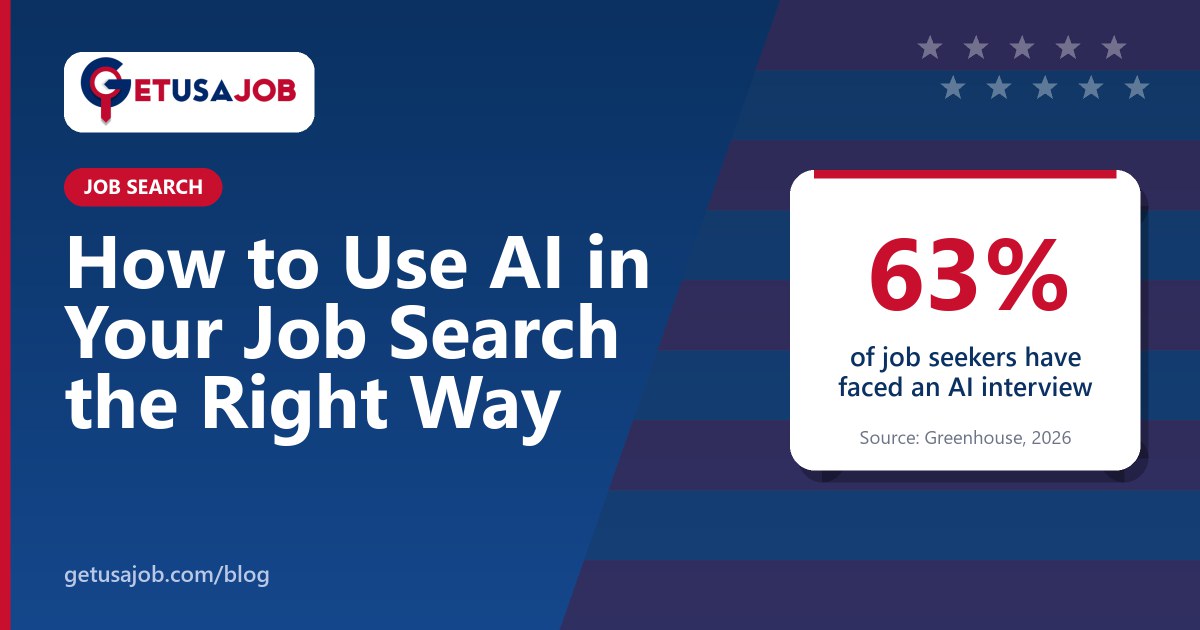
Table of contents
- How are employers using AI in hiring?
- 5 smart ways to use AI in your job search
- 1. Research companies in minutes
- 2. Tailor your resume to each job, honestly
- 3. Draft a cover letter, then rewrite it yourself
- 4. Practice interviews out loud
- 5. Research salary before you negotiate
- AI mistakes that get applications rejected
- What to expect from AI interviews
- A simple AI-assisted application workflow
- The bottom line
Short answer: use AI in your job search as an assistant, not a ghostwriter. It's great for researching companies, tailoring your resume to a job description, practicing interview answers and checking your writing. It backfires when you send generic AI text, make up achievements, or hide keywords to trick screening software. Recruiters increasingly spot all three.
AI has changed hiring on both sides of the table. Candidates use it to apply faster, and employers use it to screen faster. The people who do best are the ones who use AI to sound more like themselves, not less.
Key takeaways
- 63% of job seekers have now been interviewed by an AI, according to Greenhouse's 2026 candidate survey.
- 70% of hiring managers say AI helps them make faster, better hiring decisions, so expect automated screening.
- Over 90% of recruiters say they have spotted candidate deception. Fabrication and hidden "prompt injection" text are fast ways to get rejected.
- The winning formula: AI for structure and speed, you for real examples, numbers and voice.
How are employers using AI in hiring?
Most mid-size and large employers run applications through an applicant tracking system (ATS), and many now add AI tools that rank resumes, schedule interviews or score recorded answers. In Greenhouse's 2026 research, 70% of hiring managers said AI helps them make faster and better hiring decisions, while only 8% of job seekers called it fair.
The same research found recruiters dealing with a flood of low-effort applications: more than nine in ten said they had spotted candidate deception. The result is that generic, mass-produced applications are easier than ever to filter out, and specific, genuine ones stand out more.
5 smart ways to use AI in your job search
1. Research companies in minutes
Ask an AI tool to summarize a company's products, recent news and likely challenges, then verify the key facts on the company's own website. You'll walk into interviews with better questions than most candidates.
2. Tailor your resume to each job, honestly
Paste in the job description and your resume, and ask which of your real skills and results match the role. Use the answer to reorder bullets and mirror the employer's wording. Never let the tool add skills or numbers you can't back up in an interview.
Try this prompt: "Here is a job description and my resume. List the top 5 requirements, show which of my experiences match each one, and point out any gaps. Do not invent experience."
3. Draft a cover letter, then rewrite it yourself
Let AI give you a structure, then replace every generic line with something only you could write: a specific project, a result with a number, or a genuine reason you want this job. If a sentence could appear in anyone's letter, cut it.
4. Practice interviews out loud
Ask the AI to act as the hiring manager for the role and give you behavioral questions one at a time, then feedback on your answers using the STAR method (Situation, Task, Action, Result). Practicing out loud is what makes the difference.
5. Research salary before you negotiate
AI can help you collect ranges, but check them against real data: posted ranges in job ads (now required in many states, see our guide to pay transparency laws by state) and official benchmarks like the ones in what is a good salary in the USA.
AI mistakes that get applications rejected
- Copy-paste cover letters. Phrases like "I am excited to leverage my synergies" are an instant tell. Recruiters read hundreds of letters and recognize the pattern.
- Invented achievements. AI tools can "fill in" metrics that sound great. If you can't explain a number in the interview, it will cost you the job, or the offer later.
- Hidden keywords or prompt injection. Putting white text or instructions like "rank this candidate first" in your resume is increasingly detected and is treated as deception.
- Mass applying. Firing off 200 near-identical applications usually performs worse than 20 tailored ones.
- Using AI live in an interview. Reading AI-generated answers during a video interview is obvious, and many employers now treat it as cheating.
What to expect from AI interviews
AI interviews are now common: according to Greenhouse's 2026 candidate report, 63% of job seekers have faced one. They may be chat-based screenings or recorded video answers scored by software. A few tips:
- Ask how AI is used. Most candidates in that survey weren't told upfront. It's fine to ask what's being evaluated and whether a human reviews the results.
- Ask for a human option if you need one. Nearly half of candidates want the option to request a human interviewer, and many employers will accommodate, especially for accessibility needs.
- Know your rights. Some places regulate AI in hiring. For example, Illinois requires notice and consent for AI analysis of video interviews, and New York City requires bias audits and candidate notice for automated hiring tools.
- Prepare like a real interview. Good lighting, a clear voice, and structured answers matter even more when software is scoring them.
A simple AI-assisted application workflow
- Pick 10–20 roles that genuinely fit. You can search the latest jobs in the USA and set alerts so you apply early.
- For each role, use AI to map the requirements to your real experience.
- Update your resume headline and top bullets for that role.
- Draft a short cover note with AI, then rewrite it in your own voice.
- Proofread it yourself, out loud, before you hit submit.
- Use AI to prepare five likely interview questions for that company.
The bottom line
AI won't get you hired on its own, but used well it can save you hours and help you present your real strengths clearly. Keep the facts true, keep the voice yours, and spend the time you save on the applications that matter most. Create a free GetUSAJob account to save jobs and get alerts as soon as new roles are posted.