How to Get a Job in the USA From Another Country (2026 Guide)
A practical, step-by-step guide to landing a US job from abroad in 2026: picking the right work visa, finding employers that actually sponsor, and what the new H-1B rules mean for you.
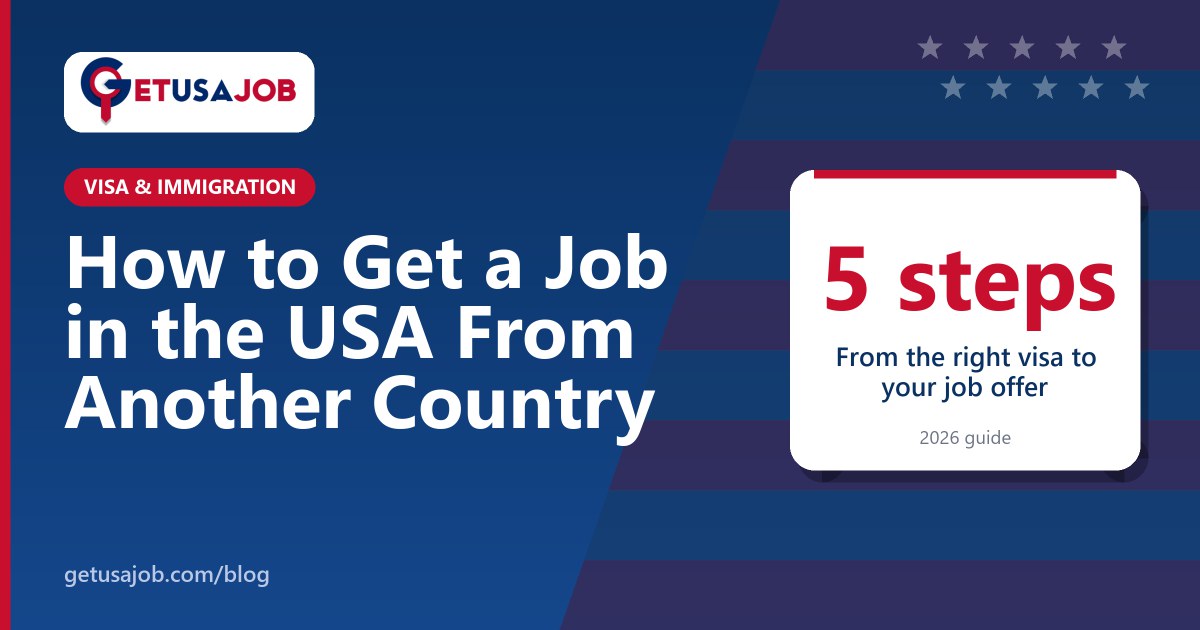
Table of contents
- Step 1: Work out which US work visa fits you
- What changed for international job seekers in 2026?
- The H-1B lottery now favors higher wages
- The $100,000 H-1B payment: where it stands
- Expect an in-person visa interview
- Step 2: Target employers that actually sponsor
- Step 3: Make your application look American
- Step 4: Interview well across time zones
- Step 5: After the offer: what happens next
- Red flags: avoid visa job scams
- Your next step
Short answer: to get a job in the USA from another country, you need two things at the same time: a US employer that wants to hire you, and a work visa that fits your nationality, skills and the job. For most people that means targeting employers that already sponsor visas (often for the H-1B, L-1, O-1, TN or E-3), applying with a US-style resume, and letting the employer file the petition once they make an offer.
That sounds simple. In practice, the order you do things in matters a lot, and 2026 brought real changes to the H-1B process. This guide walks through it step by step, in plain English.
Key takeaways
- You can't usually apply for a US work visa on your own. An employer (or, for some visas, an agent) has to sponsor you.
- Your nationality matters: Canadians and Mexicans can use the TN, and Australians can use the E-3. Both are often much faster than the H-1B.
- Since March 2026 the H-1B lottery is wage-weighted: higher-paid offers have a better chance of being selected.
- Universities, hospitals and research non-profits are often exempt from the H-1B cap, so they can hire all year.
- Never pay anyone for a "guaranteed" US job or visa.
Step 1: Work out which US work visa fits you
Before you send a single application, figure out which visa route is realistic for you. Recruiters ask this early, and a clear answer ("I'm Canadian and qualify for TN as an engineer") makes you far easier to hire.
| Visa | Who it's for | Annual cap? | Good to know |
|---|---|---|---|
| H-1B | "Specialty occupation" roles that need at least a bachelor's degree (software, engineering, finance, healthcare and more) | Yes, for most employers | Registration each March; selection is now weighted by wage level |
| L-1 | Employees transferring from a company's foreign office to its US office | No | You generally need one year of continuous work for the company abroad in the last three years |
| O-1 | People with extraordinary ability: awards, publications, high pay, major achievements | No | Evidence-heavy, but no lottery |
| TN | Citizens of Canada and Mexico in professions listed under USMCA | No | Often the fastest professional route if you qualify |
| E-3 | Australian citizens in specialty occupations | 10,500 per year | The cap is rarely reached, so it works like a faster H-1B |
| H-2A / H-2B | Seasonal or temporary farm (H-2A) and non-farm (H-2B) work | H-2B: yes, 66,000 a year plus any supplemental visas | Common in hospitality, landscaping and seafood processing |
| Employment-based green card | Permanent roles, often in nursing and shortage occupations | Yes, by category and country | Slower, but leads to permanent residence |
Each category has detailed rules, so read the official overview on the USCIS "Working in the United States" page before you commit to a route.
What changed for international job seekers in 2026?
The H-1B lottery now favors higher wages
A Department of Homeland Security rule published on December 29, 2025 replaced the purely random H-1B lottery with a weighted one, starting with the FY 2027 season that opened in March 2026. Registrations get one to four entries depending on the wage level the offered salary meets for that job and location: Level I gets one entry and Level IV gets four.
What it means for you: entry-level offers still have a chance, but strong, well-paid offers are much more likely to be picked. Target roles where your experience justifies a higher wage level, and don't undersell yourself in salary talks. Our guide to what counts as a good salary in the USA can help you benchmark.
The $100,000 H-1B payment: where it stands
A September 2025 presidential proclamation added a $100,000 payment for certain new H-1B petitions for workers outside the US, and a September 2026 proclamation extended it to September 21, 2027. However, federal courts in Massachusetts (June 2026) and California (September 30, 2026) vacated the agency guidance that implements it, so as of October 2026 the payment is not being collected. The government is appealing. This could change quickly, so check the latest USCIS H-1B updates before an employer files.
Expect an in-person visa interview
Since September 2025, the State Department has largely ended interview waivers for work visas such as the H-1B, L-1, O-1, TN and E-3. Plan for an in-person interview at a US embassy or consulate, and allow extra time, because wait times vary a lot by country. Social media and online screening has also been expanded to more visa classes, including TN professionals from October 1, 2026.
Step 2: Target employers that actually sponsor
Most rejections from abroad aren't about your skills. They happen because the company simply doesn't sponsor. Save yourself months by targeting employers with a track record:
- Check public sponsorship data. USCIS publishes an H-1B Employer Data Hub, and the Department of Labor publishes labor condition application (LCA) data showing which companies filed for which job titles and salaries.
- Look at cap-exempt employers. Universities, affiliated hospitals and non-profit research organizations can usually file H-1B petitions at any time of year without the lottery.
- Follow the shortages. Healthcare, software and cloud engineering, cybersecurity, data, and specialized engineering consistently sponsor.
- Search smart. Use terms like "visa sponsorship", "H-1B" or "TN" when you search jobs in the USA, and set up alerts so you can apply in the first few days.
Step 3: Make your application look American
Hiring managers in the US expect a particular format. A resume that's perfect in your home country can look odd here.
- No photo, date of birth or marital status. US employers avoid these to reduce bias.
- One to two pages, focused on results. "Cut cloud costs 28%" beats "responsible for cloud infrastructure".
- Translate your context. Name companies' size or industry, convert currencies to USD, and explain local degrees ("equivalent to a US bachelor's degree").
- Be upfront but brief about status. One line such as "Canadian citizen — eligible for TN" or "Will require H-1B sponsorship" saves everyone time.
Step 4: Interview well across time zones
Most first interviews for international candidates happen on video. Treat them exactly like an in-person meeting: test your connection, use a quiet room, and confirm the time zone in writing, because "9 a.m. Eastern" is a classic source of missed calls.
If the employer hasn't asked about sponsorship by the end of the first conversation, it's fine to raise it: "Just so you have the full picture, I'd need H-1B sponsorship. Is that something your team has done before?" Asking early and confidently comes across far better than surprising them at the offer stage.
Step 5: After the offer: what happens next
- The employer files. Depending on the visa, that may mean an LCA with the Department of Labor, then a petition with USCIS (TN and E-3 applicants can often go straight to a consulate).
- You apply for the visa. Complete the DS-160 form, pay the fee, and book your consular interview.
- Bring the right documents. Passport, approval notice (if any), offer letter, degree certificates and evidence of your experience.
- Plan your start date realistically. H-1B cap jobs normally start on October 1 at the earliest. TN and E-3 can be a matter of weeks.
Red flags: avoid visa job scams
International candidates are a favorite target for scammers. Walk away if someone asks you to pay for a job, a "visa slot" or a "guaranteed" sponsorship, or if an offer arrives without a real interview. Legitimate employers pay their own sponsorship filing fees for most work visas. You can check an employer by visiting its official careers page and contacting it directly.
Your next step
Getting a job in the USA from another country takes longer than a domestic job search, but it's very achievable with the right visa route and the right employers. Create a free GetUSAJob account, upload a US-style resume, and set alerts for roles that mention sponsorship so you're among the first to apply.
This guide is general information, not legal advice. Immigration rules change often, so confirm details with USCIS, the U.S. Department of State or an immigration attorney before you make decisions.