15 Highest-Paying Jobs Without a Degree in the USA (2026 Data)
You don't need a four-year degree to earn a strong salary. These 15 jobs pay well above the US median, based on the latest Bureau of Labor Statistics data, with the training each one takes and how fast it's growing.
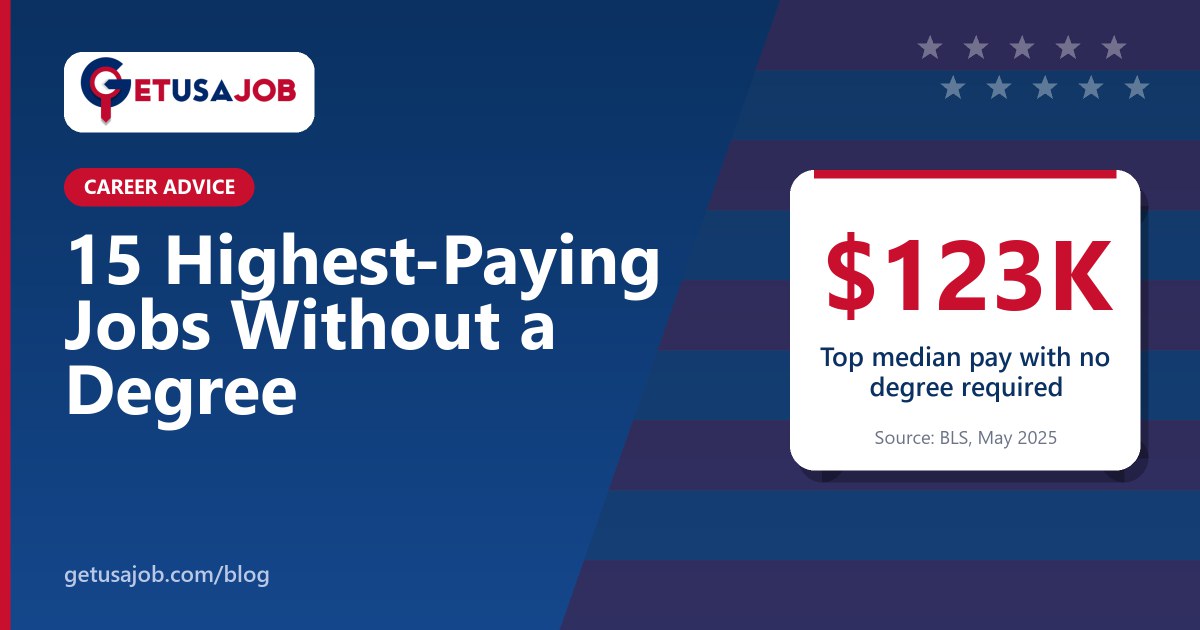
Table of contents
- Highest-paying jobs without a degree: the full list
- Which jobs pay the most without a degree?
- Aviation: highest pay, biggest upfront investment
- Energy and utilities: steady, well-paid shift work
- Skilled trades: earn while you learn
- Logistics and management: climb with experience
- How to get one of these jobs
- Is a job without a degree worth it?
- Start your search
Short answer: the highest-paying jobs without a degree in the USA include commercial pilot ($123,220), nuclear power reactor operator ($122,890), elevator and escalator installer ($109,910), transportation and logistics manager ($107,230) and electrical power-line installer ($95,320). These are median annual wages from the U.S. Bureau of Labor Statistics (BLS) for May 2025. Most of these jobs need a high school diploma plus an apprenticeship, a license or several years of on-the-job training, not a four-year degree.
For comparison, the median wage across all US occupations was $50,980. Every job on this list beats that, and several pay roughly double.
Key takeaways
- The best-paying non-degree jobs are mostly in skilled trades, energy, aviation and logistics.
- Many trade apprenticeships are paid, so you earn while you train instead of taking on student debt.
- Wind turbine technicians are the fastest-growing role here, projected to grow 30% from 2025 to 2035.
- "No degree" rarely means "no training". Expect 2–5 years of apprenticeship, certification or experience.
Highest-paying jobs without a degree: the full list
| # | Job | Median pay (May 2025) | Typical path in | Job outlook 2025–35 |
|---|---|---|---|---|
| 1 | Commercial pilot | $123,220 | Flight training and FAA commercial pilot certificate | +7% (all pilots) |
| 2 | Nuclear power reactor operator | $122,890 | High school diploma + long-term training and license | −4% (power plant group) |
| 3 | Elevator and escalator installer/repairer | $109,910 | High school diploma + ~4-year apprenticeship | +6% |
| 4 | Transportation, storage and distribution manager | $107,230 | High school diploma + 5+ years of related experience | +6% |
| 5 | Power plant operator | $102,040 | High school diploma + long-term on-the-job training | −4% (power plant group) |
| 6 | Electrical power-line installer/repairer | $95,320 | High school diploma + apprenticeship (up to ~3 years) | +10% |
| 7 | Detective and criminal investigator | $93,790 | Varies by agency; often police experience | +3% (police and detectives) |
| 8 | Aircraft and avionics mechanic | $80,180 | FAA-approved certificate program | +6% |
| 9 | Boilermaker | $76,410 | High school diploma + ~4-year apprenticeship | −2% |
| 10 | Construction and building inspector | $74,690 | High school diploma + 5+ years in a trade | 0% |
| 11 | Wind turbine technician | $64,120 | Postsecondary certificate + on-the-job training | +30% |
| 12 | Plumber, pipefitter, steamfitter | $63,800 | High school diploma + 4–5 year apprenticeship | +7% |
| 13 | Flight attendant | $63,580 | High school diploma + airline training | +9% |
| 14 | Electrician | $63,190 | High school diploma + 4–5 year apprenticeship | +9% |
| 15 | Heavy and tractor-trailer truck driver | $58,640 | High school diploma + truck-driving school and CDL | +4% |
Source: BLS Occupational Outlook Handbook, May 2025 median wages and 2025–35 projections. Half of workers in each job earn more than the median and half earn less.
Which jobs pay the most without a degree?
Aviation: highest pay, biggest upfront investment
Commercial pilots fly charters, tours, cargo, firefighting and medical flights. You need FAA certificates and flight hours rather than a degree, though flight training is expensive. Airline pilots earn more ($232,140 median), but major airlines typically want a bachelor's degree. Aircraft mechanics are a lower-cost way into aviation: an FAA-approved program takes around 18–24 months.
Energy and utilities: steady, well-paid shift work
Power plant and nuclear reactor operators run the systems that keep the lights on. The pay is excellent, but overall employment is projected to decline slightly as plants become more automated. Most openings come from retirements, so competition can be stiff. Power-line installers, on the other hand, are growing quickly (+10%) as the grid is upgraded.
Skilled trades: earn while you learn
Elevator installers top the trades for pay. Electricians and plumbers have lower medians, but there are far more jobs (about 821,000 electricians alone), strong demand, and the chance to earn much more as a licensed master or business owner. Apprenticeships combine roughly 2,000 hours of paid on-the-job training a year with classroom learning.
Logistics and management: climb with experience
Transportation and warehouse managers often start as material movers, drivers or clerks and work their way up. With five or more years of experience, the median pay passes $107,000, with no degree required by most employers.
How to get one of these jobs
- Pick a path that fits you. Do you like working outdoors, at heights, with your hands, or managing people? Be honest. Many of these jobs involve shifts, travel or physically demanding work.
- Find an apprenticeship. Apprenticeship.gov lists registered programs, and local unions and trade associations run many of the best ones.
- Get the license or certificate. Electricians, plumbers, pilots, mechanics and truck drivers all need state or federal credentials. Factor in the time and cost.
- Start in an entry role. Helper, trainee and apprentice jobs are often posted year-round. You can search entry-level jobs in the USA and filter by your city.
- Keep stacking skills. Extra certifications (welding, high-voltage, safety) and a clean safety record often lead to the biggest raises.
Is a job without a degree worth it?
It can be, especially if you'd otherwise borrow heavily for college. Workers with a bachelor's degree still earn more on average: their median is about $1,768 a week compared with $994 for high school graduates, according to BLS. But that average hides a huge range. A licensed elevator mechanic can out-earn many graduates, without the student loans. If you're weighing offers, our guide to what counts as a good salary in the USA shows how your pay compares.
Start your search
The trades and technical jobs on this list are hiring across the country. Create a free GetUSAJob account to get alerts for apprenticeship, trainee and technician roles near you.