What Is a Good Salary in the USA in 2026? (Real Numbers)
The typical full-time worker in the USA earns about $65,000 a year, but "good" depends on where you sit in the pay range, your age, your education and your city. Here are the latest official numbers and a simple way to judge any offer.
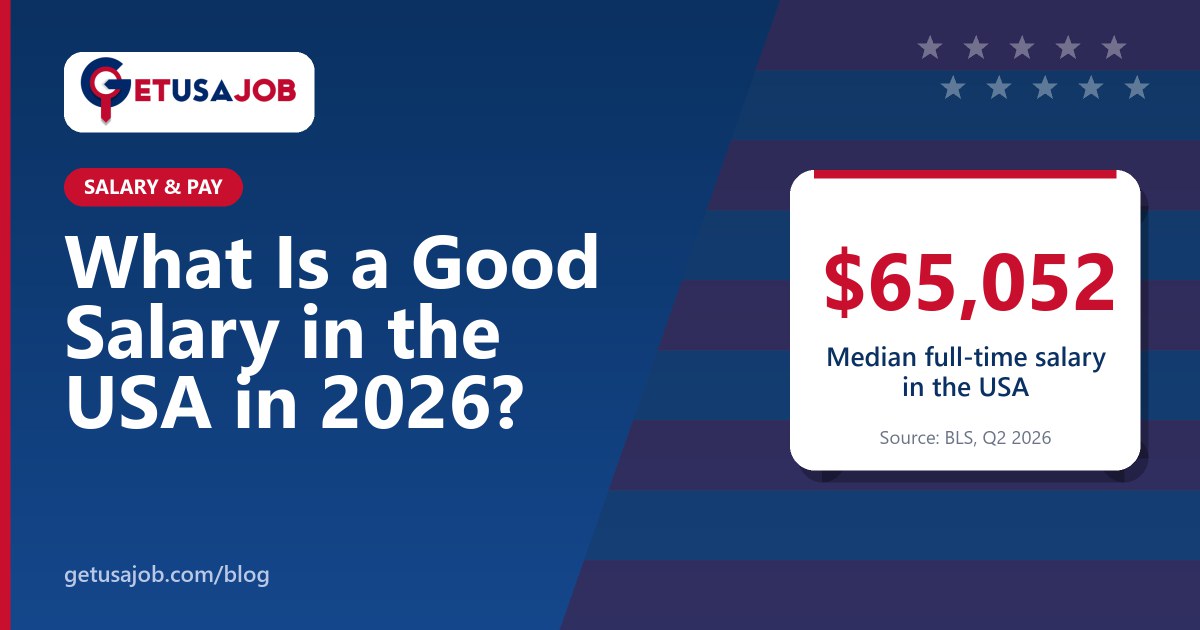
Table of contents
- What is the median salary in the USA right now?
- Where does your salary rank? US pay percentiles
- What is a good salary for your age?
- How much does education change your pay?
- Why do salary numbers online disagree?
- How to decide if a salary is good for you
- 1. Adjust for where you live
- 2. Run the 50/30/20 check
- 3. Compare against your actual job market
- 4. Look at total compensation
- Find a job that pays what you're worth
Short answer: a good salary in the USA in 2026 is anything above about $65,000 a year for a full-time job. That is the national median, so earning more than that puts you ahead of half of all full-time workers. Around $100,000 puts you in roughly the top quarter, and about $152,000 puts you in the top 10%. What feels "good" for you still depends on your city, household and career stage.
Salary numbers online are all over the place because they measure different things. Below we use the most reliable public source, the U.S. Bureau of Labor Statistics (BLS), and explain exactly what each number means, so you can judge a job offer with confidence.
Key takeaways
- Median full-time pay was $1,251 a week in Q2 2026, or about $65,052 a year (BLS).
- That was up 4.6% from a year earlier, slightly ahead of 3.9% inflation.
- Workers with a bachelor's degree or higher earned a median of about $91,900 a year, compared with about $51,700 for high school graduates.
- The median household income was $87,460 in 2025 (Census Bureau), because many households have more than one earner.
What is the median salary in the USA right now?
According to the BLS Usual Weekly Earnings report for the second quarter of 2026, the median full-time wage and salary worker earned $1,251 per week. Multiply by 52 weeks and you get roughly $65,052 a year, or about $31.28 an hour for a 40-hour week.
"Median" means half of full-time workers earn more and half earn less. It is more useful than the average, which gets pulled up by a small number of very high earners.
Where does your salary rank? US pay percentiles
This table shows where different annual salaries fall among the roughly 121 million people working full time in the USA. Annual figures are the BLS weekly numbers multiplied by 52.
| Percentile | Weekly earnings | Approx. annual salary | What it means |
|---|---|---|---|
| 10th | $642 | $33,384 | 9 in 10 full-time workers earn more |
| 25th | $850 | $44,200 | Lower end of typical pay |
| 50th (median) | $1,251 | $65,052 | Exactly in the middle |
| 75th | $1,915 | $99,580 | Top quarter of earners |
| 90th | $2,924 | $152,048 | Top 10% of earners |
Source: BLS, Usual Weekly Earnings of Wage and Salary Workers, Q2 2026 (not seasonally adjusted).
What is a good salary for your age?
Pay usually rises quickly through your late 20s and 30s, then levels off. If you're 26 and earning $60,000, you're doing better than the typical person your age, even though you're below the overall median.
| Age group | Median weekly earnings | Approx. annual salary |
|---|---|---|
| 16–24 | $806 | $41,912 |
| 25–34 | $1,160 | $60,320 |
| 35–44 | $1,436 | $74,672 |
| 45–54 | $1,421 | $73,892 |
| 55–64 | $1,367 | $71,084 |
| 65 and over | $1,233 | $64,116 |
How much does education change your pay?
Education is still one of the biggest predictors of earnings. Among full-time workers aged 25 and over in Q2 2026:
- Less than a high school diploma: $803 a week (about $41,756 a year)
- High school graduate, no college: $994 a week (about $51,688)
- Some college or associate degree: $1,125 a week (about $58,500)
- Bachelor's degree or higher: $1,768 a week (about $91,936)
A degree isn't the only path to strong pay, though. Skilled trades and technical roles can beat the median comfortably. See our list of the highest-paying jobs without a degree.
Why do salary numbers online disagree?
You'll often see different "average salary" figures. The main reasons:
- Full-time vs. all workers. The $65,052 figure covers full-time employees only. The BLS occupational survey reports a median of $50,980 for all workers in May 2025, and that figure includes part-time jobs.
- Individual vs. household. The Census Bureau's median household income was $87,460 in 2025, a record high, but it adds together everyone's income in the home.
- Median vs. mean. Averages are higher because very large salaries pull them up.
How to decide if a salary is good for you
1. Adjust for where you live
$70,000 goes a lot further in Oklahoma City than in San Francisco or New York. Before you accept an offer, compare rent and living costs for that city. The MIT Living Wage Calculator and the Bureau of Economic Analysis regional price data are good free starting points.
2. Run the 50/30/20 check
A simple budgeting rule: about 50% of take-home pay for needs (housing, food, transport), 30% for wants and 20% for savings and debt. If rent alone would take more than about a third of your take-home pay, the salary is tight for that city.
3. Compare against your actual job market
National medians are a starting point. What matters most is pay for your role, level and location. Many states now require employers to publish salary ranges in job ads, which makes this much easier. See our guide to pay transparency laws by state.
4. Look at total compensation
Health insurance, retirement matching, bonuses, paid time off and remote work can be worth thousands of dollars a year. A $68,000 job with strong benefits can beat a $72,000 job with poor ones.
Find a job that pays what you're worth
Use these numbers as a benchmark, not a ceiling. If you're earning below the median for your age and field, a move could be the fastest way to a raise. Browse the latest jobs in the USA and compare posted salary ranges for your role.