Library Jobs in the USA (2026): With and Without an MLIS
You do not need a master's degree for every library job. Here is how library careers actually work, what librarians and library assistants earn, and where to find openings at public, school and university libraries.
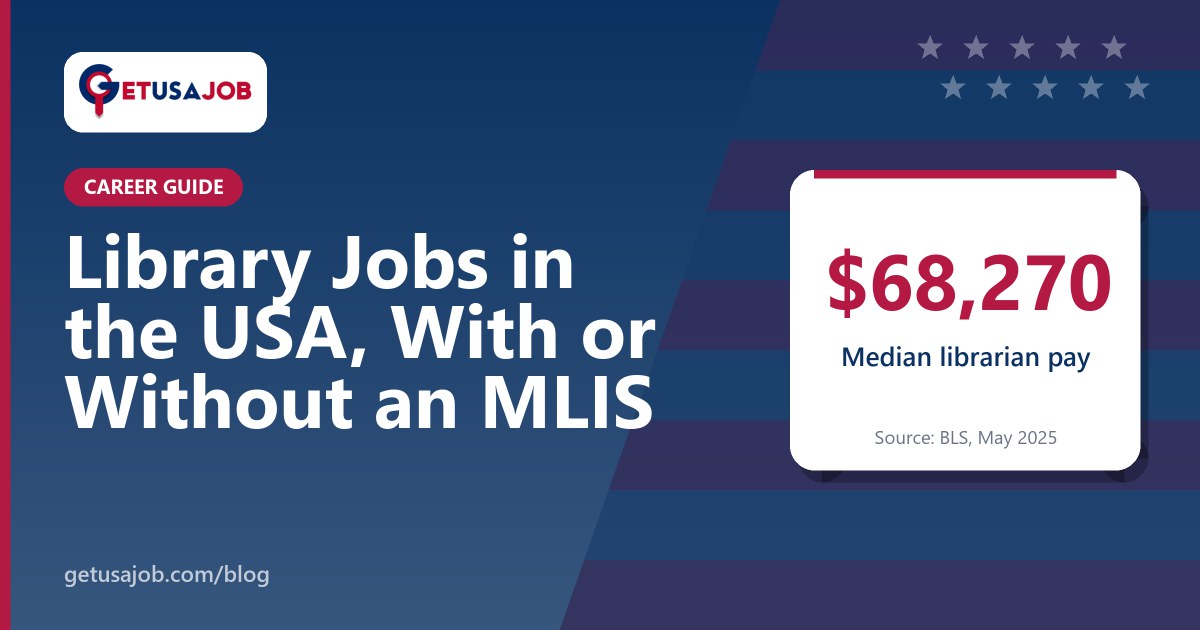
Table of contents
Short answer: library jobs in the USA fall into two groups. Professional librarian jobs usually need a master's degree from an ALA-accredited program (MLIS or MLS) and pay a median of $68,270 a year. Library assistant, technician, clerk and page jobs usually need a high school diploma or some college and pay a median of $38,760 (BLS, May 2025). Most public library jobs are posted on city or county government job sites, not just on library websites.
Library jobs are a steady search on GetUSAJob, especially local searches such as "library jobs Denver", "library jobs Portland" and "librarian jobs San Antonio". Many people assume every library role needs a master's degree. It does not, and knowing the difference saves a lot of time.
Key takeaways
- Librarians and library media specialists earned a median of $68,270 in May 2025 (BLS).
- Library technicians and assistants earned a median of $38,760.
- BLS expects about 12,600 librarian openings a year through 2035, mostly from retirements and job changes.
- School and university librarians earn the most, with medians around $74,000.
What library jobs are there?
| Job | What it involves | Usual requirement |
|---|---|---|
| Library page / shelver | Shelving, sorting returns, tidying collections | Often open to high school students |
| Library assistant / clerk | Circulation desk, holds, patron accounts, basic help | High school diploma; customer service experience |
| Library technician / associate | Cataloging support, programs, tech help, interlibrary loan | Some college or associate degree |
| Librarian (public) | Reference, children's, teen, adult services, collection development | ALA-accredited MLIS or MLS |
| School librarian / media specialist | Teaching information literacy, running the school library | State school library certification; often a teaching license |
| Academic librarian | Research help, subject liaison, instruction, special collections | MLIS; a second subject master's for some roles |
| Specialist roles | Cataloging and metadata, systems, digital services, archives | MLIS plus technical skills |
| Branch manager | Running a branch, staff and budget | MLIS plus supervisory experience |
How much do library jobs pay?
The BLS Occupational Outlook Handbook shows how much the employer type matters for librarians (median pay, May 2025):
- Local elementary and secondary schools: $74,710
- State colleges and universities: $74,490
- Private colleges and universities: $73,700
- Local government (most public libraries): $62,860
- Libraries, archives and information services: $60,360
Library assistants and technicians are usually paid hourly. In cities with high minimum wages or union contracts, starting pay can be well above the national median. Because most public libraries are government employers, the salary range is almost always published in the job posting.
Can you work in a library without a degree?
Yes. Pages, assistants, clerks and many technician roles do not require a degree, and they make up a large share of library staff. They are also how many librarians start: working as a library assistant while studying for an MLIS is a common path, and some library systems help pay tuition for staff.
What helps you get hired without a degree:
- Customer service experience, especially with children, older adults or the public
- Comfort with technology: helping people with phones, printers, e-books and online forms is now a big part of the job
- A second language, particularly Spanish, in many communities
- Reliability for evening and weekend shifts
How to become a librarian
- Earn a bachelor's degree in any subject. Librarians come from every background.
- Complete an ALA-accredited master's (MLIS, MLS or MSIS). Many programs are online. Many public and academic employers specifically require ALA accreditation.
- Get experience during the degree by working as a library assistant, intern or graduate assistant.
- Check state rules if you want to be a school librarian. Most states require a school library certification, and many also require a teaching license.
- Specialize where there is demand. Children's and teen services, cataloging and metadata, data and digital services, and bilingual outreach are often harder to fill than general reference roles.
Where are library jobs posted?
- City and county job sites: most public libraries hire through local government. For example, Denver Public Library jobs are posted through the City and County of Denver, and Multnomah County Library jobs through Multnomah County.
- School district and university career pages for school and academic libraries.
- State library job boards and the American Library Association's JobLIST.
- GetUSAJob: we collect library, archive and museum jobs from across the country. Browse education and library jobs.
Tips for a library job application
Public library hiring often follows civil service rules, so details matter. Answer every supplemental question fully, because many systems score those answers before a person reads your resume. Use the exact words from the posting, such as "reader's advisory", "programming" or "integrated library system", where they genuinely match your experience. In interviews, expect scenario questions about difficult patrons, privacy, and helping someone with technology, and have a short story ready for each. Finally, apply to several nearby systems at once: county, city and university libraries often hire on different schedules.
Library, archive or museum?
The three fields overlap a lot. Archivists often hold an MLIS, museums hire librarians for research libraries, and many public libraries now run exhibitions and local history collections. If you enjoy collections and research, read how to become a curator or archivist and how to get a museum job.
Ready to apply? Search the latest jobs in the USA and filter by your city to find library openings near you.