How to Become a Curator or Archivist in the USA (2026): Degrees, Pay, Jobs
Curator, archivist, registrar and conservator jobs are among the most-searched museum careers. Here is the realistic route into each, with the latest BLS pay data and the entry-level titles to apply for first.
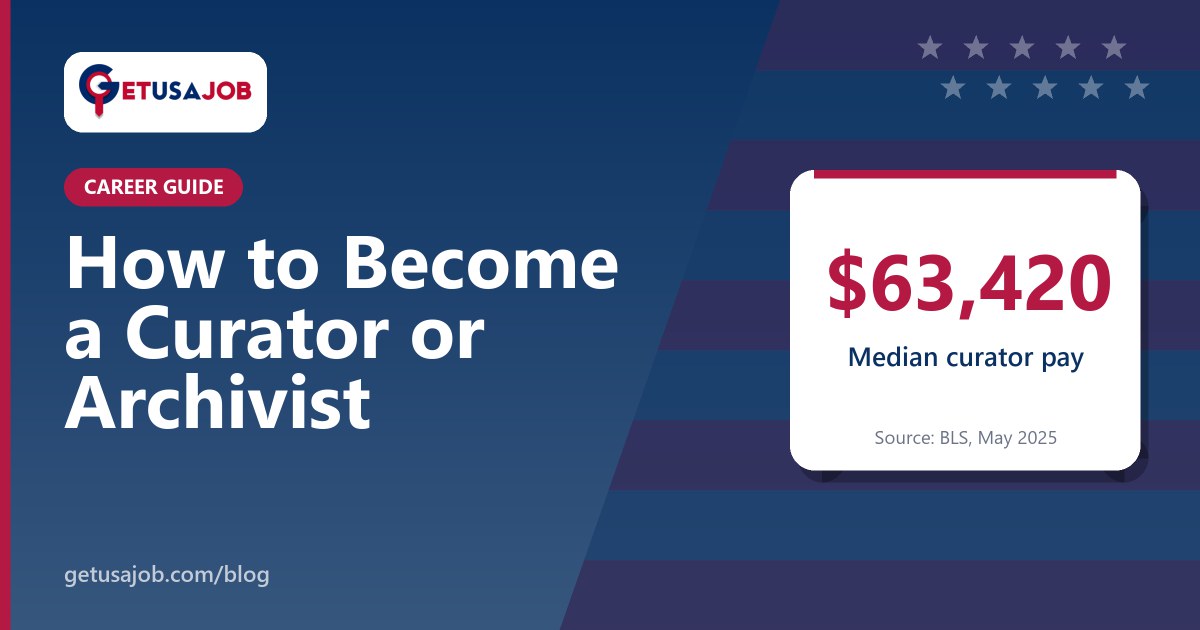
Table of contents
- Curator vs archivist vs registrar vs conservator
- How to become a curator
- 1. Choose your subject
- 2. Get a master's degree (and decide whether you need a PhD)
- 3. Start as a curatorial assistant
- 4. Build a record you can show
- How to become an archivist
- 1. Get the right graduate degree
- 2. Learn processing and description standards
- 3. Consider certification
- 4. Look beyond museums
- How to become a registrar or conservator
- Where are curator and archivist jobs?
Short answer: to become a curator in the USA you usually need a master's degree in a subject such as art history, history, anthropology or museum studies, plus several years of hands-on collections or research experience, often starting as a curatorial assistant. To become an archivist you usually need a master's degree in library and information science (with an archives focus) or in history, plus practical processing experience. The BLS reports median pay of $63,420 for curators and $64,550 for archivists (May 2025).
Searches such as "museum curator jobs", "archivist jobs", "curatorial assistant jobs" and "museum registrar jobs" bring thousands of people to GetUSAJob every month. These are rewarding careers, but the routes into them are not obvious. This guide explains them step by step.
Key takeaways
- There were about 14,200 curators and 10,300 archivists in the USA in 2025 (BLS).
- BLS projects growth of 5% for curators and 3% for archivists from 2025 to 2035.
- Museum technicians and conservators earned a median of $51,440; conservators need specialist graduate training.
- Most curators and archivists start in assistant, technician or project roles, not in the job title they ultimately want.
Curator vs archivist vs registrar vs conservator
These roles are often confused, and job titles vary between institutions. Here is how they usually differ.
| Role | What they do | Typical education | US median pay (May 2025) |
|---|---|---|---|
| Curator | Researches and builds the collection, develops exhibitions, writes and speaks about the work | Master's degree; PhD for senior roles at large museums | $63,420 |
| Archivist | Appraises, arranges, describes and preserves records and makes them accessible | MLIS with archives focus, or history MA | $64,550 |
| Registrar / collections manager | Tracks objects, loans, insurance, shipping and the collections database | Bachelor's or master's degree plus database skills | Usually reported with museum technicians: $51,440 |
| Conservator | Examines, treats and preserves objects using scientific methods | Graduate conservation degree (master's) | Reported with museum technicians: $51,440 |
Source: U.S. Bureau of Labor Statistics, Occupational Outlook Handbook.
How to become a curator
1. Choose your subject
Curators are subject specialists first. An art museum curator usually has an art history degree, a natural history curator a science degree, and a history museum curator a history or American studies degree. Pick the field you want to curate, not just "museums".
2. Get a master's degree (and decide whether you need a PhD)
A master's is the usual entry point. Large art and natural history museums often expect a PhD for associate and full curator roles. Museum studies programs are helpful for practical skills, but at big institutions they are usually paired with subject expertise.
3. Start as a curatorial assistant
Curatorial assistant, research assistant and collections assistant are the real entry-level titles. These roles involve object research, image rights, checklists, label drafts and exhibition logistics. They are the jobs to search for, and they are where most curators begin.
4. Build a record you can show
Exhibitions you helped deliver, catalog essays, published research and talks matter more than course grades. Keep a simple list or portfolio of every project with your role in it.
How to become an archivist
1. Get the right graduate degree
Most archivist postings ask for an ALA-accredited MLIS or MLS with an archives concentration, or a master's in history or public history with archival coursework. Many employers state the ALA-accredited degree explicitly.
2. Learn processing and description standards
Practical skills employers look for include arranging and describing collections, writing finding aids, using DACS and EAD, digitization, and systems such as ArchivesSpace. Digital preservation and records management experience is increasingly valuable.
3. Consider certification
The Academy of Certified Archivists offers the Certified Archivist (CA) credential. It is not required for most jobs but is respected, especially in government and corporate archives.
4. Look beyond museums
Archivists work in universities, state and federal government, corporations, religious organizations, hospitals and law firms. Government and higher education often pay above the museum median and publish their salary scales.
How to become a registrar or conservator
Registrars and collections managers often come from collections assistant and art handling roles. Strong database skills, attention to detail and knowledge of loans, packing and insurance matter more than an advanced degree, although many have one.
Conservators follow the most structured route. Admission to a graduate conservation program usually requires chemistry coursework, studio art or art history, and pre-program experience working under a conservator. Graduates then often complete fellowships before permanent roles. The American Institute for Conservation lists accredited routes and job openings.
Where are curator and archivist jobs?
BLS data shows that only 36% of these specialists work in museums and historical sites. Another 23% work in government and 16% in schools, colleges and universities. On GetUSAJob, the most active markets for these roles include New York, Washington, DC, Chicago, Boston, Seattle and Portland. See our guides to museum jobs in Chicago and museum jobs in Seattle.
If you are deciding between archives and libraries, read our guide to library jobs in the USA, since the two careers share degrees and employers. For a broader view of the sector, see how to get a museum job.
Browse the latest museum and curator jobs in the USA on GetUSAJob, updated every day.