How to Get a Museum Job in the USA (2026): Roles, Pay and Where to Look
Museums hire far more than curators. Here is what the jobs actually are, what they pay according to the latest BLS data, which qualifications matter, and how people really get their first museum job.
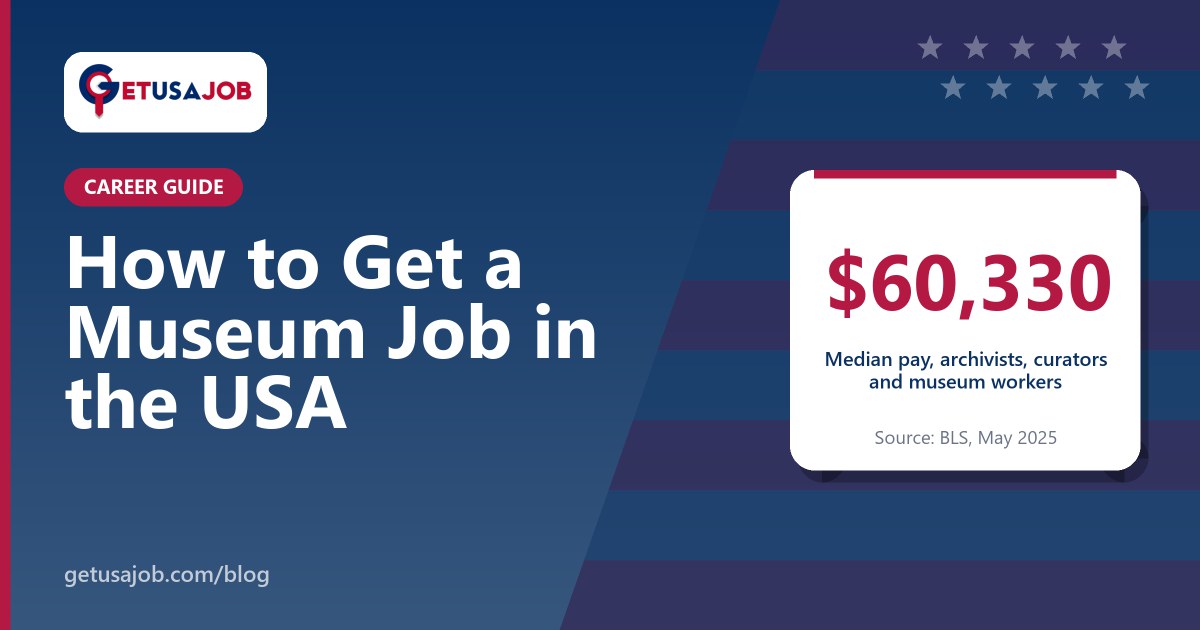
Table of contents
- What kinds of museum jobs are there?
- How much do museum jobs pay?
- Do you need a degree to work in a museum?
- How do people actually get their first museum job?
- 1. Get in the building, in any role
- 2. Do internships and volunteer work that produce evidence
- 3. Learn the tools
- 4. Be flexible on place
- 5. Write a museum-specific resume and cover letter
- Where are museum jobs posted?
- Is a museum career worth it?
Short answer: most people get a museum job in the USA by starting in a front-line or project role (visitor services, education, collections assistant, development or retail), building experience through internships or volunteering, and moving across or up within a few years. Curatorial and conservation roles usually need a master's degree, but at least half the jobs in a typical museum do not. Pay is modest: the BLS puts the median for archivists, curators and museum workers at $60,330 a year (May 2025).
Museum jobs are some of the most-searched roles on GetUSAJob. They are also some of the most competitive, because the number of people who would love to work in a museum is far larger than the number of openings. The good news is that the field is bigger and more varied than most applicants realize, and knowing how hiring actually works gives you a real edge.
Key takeaways
- About 181,600 people work in US museums, historical sites and similar institutions (BLS, March 2026).
- Median pay: archivists $64,550, curators $63,420, museum technicians and conservators $51,440 (BLS, May 2025).
- BLS expects about 4,300 openings a year for archivists, curators and museum workers through 2035, mostly to replace people who leave.
- Only 36% of these specialists work in museums themselves. Government (23%) and colleges and schools (16%) are big employers too.
What kinds of museum jobs are there?
A mid-sized art, history or science museum is a small company with many departments. Here is what you will see in museum job listings, grouped roughly by how much prior experience they need.
| Department | Typical job titles | Usual entry requirement |
|---|---|---|
| Visitor experience | Visitor services associate, gallery ambassador, admissions, museum attendant | High school diploma; customer service experience |
| Education and programs | Museum educator, school programs coordinator, teen program facilitator | Bachelor's degree; teaching or camp experience helps |
| Collections | Collections assistant, museum technician, art handler, preparator, registrar | Bachelor's degree plus hands-on object handling |
| Curatorial | Curatorial assistant, assistant/associate curator, curator | Master's degree (PhD for senior roles at large museums) |
| Conservation | Conservation technician, assistant conservator, conservator | Graduate conservation degree for conservators |
| Exhibitions | Exhibitions project manager, exhibit designer, AV and media technician | Design, fabrication or project management experience |
| Development and marketing | Membership coordinator, grants writer, marketing associate | Bachelor's degree; writing and sales skills |
| Operations | Security officer, facilities technician, retail associate, events staff | Varies; often no degree needed |
Zoos, aquariums, botanical gardens, historic houses, presidential libraries and university galleries hire for the same kinds of roles. If you search only for "curator" you miss most of the market.
How much do museum jobs pay?
The U.S. Bureau of Labor Statistics Occupational Outlook Handbook reports these medians for May 2025:
- Archivists: $64,550 a year
- Curators: $63,420 a year
- Museum technicians and conservators: $51,440 a year
- All occupations in the USA (for comparison): $50,980 a year
Where you work matters. The same BLS data shows medians of about $64,340 in educational institutions and $63,630 in government, compared with $56,840 inside museums and historical sites. That is one reason the Smithsonian, the National Park Service, state archives and university museums attract so many applicants: federal and state pay scales are published and benefits are strong.
Front-line roles pay hourly, often close to the local minimum wage plus a few dollars. Many states and cities, including California, Colorado, Illinois, New York and Washington, now require pay ranges in job ads, so you can compare offers before you apply. See our guide to pay transparency laws by state.
Do you need a degree to work in a museum?
It depends on the job, and this is where many applicants waste time.
- No degree usually needed: visitor services, security, retail, events, facilities and many part-time education roles.
- Bachelor's degree usually expected: educators, collections assistants, marketing, development and exhibitions roles. The subject matters less than you think. Art history, history, anthropology, biology, education and communications all show up.
- Master's degree usually expected: curators, archivists and conservators. Common routes are a museum studies MA, a subject MA or PhD (for example art history or paleontology), or an MLIS with an archives focus.
A master's degree without hands-on experience is a weak combination. Hiring managers consistently say they look first for evidence that you have handled objects, run a program, written labels or worked with the public.
How do people actually get their first museum job?
1. Get in the building, in any role
Internal candidates have a big advantage. A visitor services or retail job gets you known by curators and educators, lets you see internal postings early, and gives you real museum experience for your resume. Many collections and education staff started this way.
2. Do internships and volunteer work that produce evidence
Choose projects with an output you can point to: a cataloging project with a record count, a school program you delivered, an exhibition label you wrote. Paid internships are growing, and some museums now pay all interns, so look for those first.
3. Learn the tools
Collections databases (such as TMS, PastPerfect, CollectiveAccess or Axiell), basic photography, Excel, a CRM like Tessitura or Raiser's Edge, and Adobe design software all appear regularly in museum job descriptions. Listing one you have actually used is a real differentiator.
4. Be flexible on place
Big-city museums get hundreds of applications per opening. Regional, university and county museums often struggle to fill the same roles. Two years at a small historical society can be worth more than a year of waiting for a famous museum.
5. Write a museum-specific resume and cover letter
Mirror the language in the posting, quantify your experience (visitors served, objects processed, students taught), and say why this institution's collection or mission matters to you. Generic "I have always loved museums" letters do not stand out.
Where are museum jobs posted?
- Job boards: museum jobs on GetUSAJob, updated daily, plus the American Alliance of Museums' JobHQ and discipline associations such as the Society of American Archivists and the American Institute for Conservation.
- Government portals: Smithsonian and National Park Service jobs are posted on USAJOBS. State museums, archives and county historical sites use state and county career sites.
- Regional museum associations: groups such as the New England Museum Association, Western Museums Association and Association of Midwest Museums run active job boards.
- Museum websites: most institutions post every opening on their own careers page first.
The strongest museum job markets on our site right now are in New York, Washington, DC, Chicago, Boston, Seattle and Portland, Oregon. Read our local guides to museum jobs in Chicago, museum jobs in Seattle and museum and art jobs in Portland, Oregon.
Is a museum career worth it?
Honestly, it depends on what you want. Pay is lower than in many fields with similar education, and senior curatorial jobs are scarce. On the other hand, museum work is stable for people who build transferable skills in education, collections management, fundraising or digital media, and those skills also open doors at libraries, universities, foundations and government agencies. If you want to go the specialist route, read our guide on how to become a curator or archivist.
Ready to start? Browse the latest museum jobs in the USA and set up a free account to apply.