Art Gallery Jobs (2026): Gallery Assistant, Sales, Art Handler and Director Roles
Art galleries hire assistants, registrars, art handlers, sales staff and directors. Here is how commercial and nonprofit galleries differ, what each role does, what BLS data says the closest jobs pay, and how to get your first gallery job.
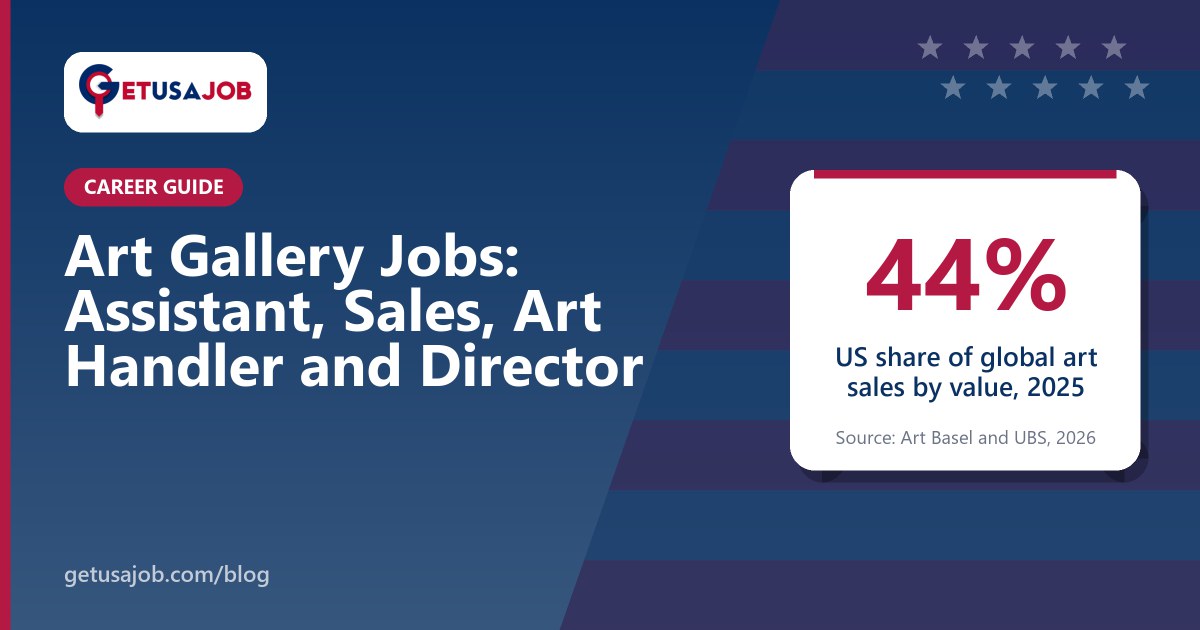
Table of contents
- Commercial galleries vs nonprofit and museum galleries
- Art gallery job titles and what they do
- How much do art gallery jobs pay?
- Pay ranges in job ads
- The main US gallery cities
- New York City
- Los Angeles
- Chicago
- How to get a job in an art gallery
- Know the gallery's program
- Start as a gallery assistant or in art handling
- Build the skills galleries ask for
- Use internships and art fairs carefully
- Watch out for fake job offers
- Keep a sharp, simple resume
- Related guides
Short answer: art gallery jobs range from gallery assistant and front desk roles to registrars, art handlers (also called preparators), sales associates, gallery managers and directors. Commercial galleries sell art and often pay sales staff partly by commission. Nonprofit and museum galleries pay salaries and hourly wages, usually lower ones. The biggest markets are New York, Los Angeles and Chicago. BLS has no category for gallery jobs, but the closest ones help: museum technicians, which covers registrars and preparators, earned a median of $51,440 in May 2025.
"Art gallery jobs" is one of the most common searches on GetUSAJob's arts pages, along with city searches such as "art gallery jobs Chicago" and "art gallery jobs NYC". This guide explains how the gallery world is organized, what each job involves, what the pay data shows, and how people get their first gallery job.
Key takeaways
- The US is the world's biggest art market: 44% of global art sales by value in 2025, about $26.0 billion, according to the Art Basel and UBS Global Art Market Report 2026.
- Commercial galleries sell art, so sales jobs often include commission and pay varies widely. Nonprofit galleries pay set wages.
- The usual first job is gallery assistant. Registrar and art handler jobs are a hands-on route that also leads to museums.
- In New York City, California and Illinois, most gallery job ads have to show a pay range.
Commercial galleries vs nonprofit and museum galleries
The word "gallery" covers two quite different kinds of employer, and it helps to know which one you are applying to.
Commercial galleries are businesses. They represent artists, put on exhibitions and sell the work to collectors, museums and companies, often also at art fairs. They range from one-person spaces to international galleries with locations in several countries. Pace Gallery, for example, has galleries in New York and Los Angeles as well as London, Geneva, Seoul, Hong Kong and Tokyo. Commercial galleries hire for sales, client relations, artist liaison, registration, art handling, operations and marketing. Sales results matter, and senior sales jobs can pay well.
Nonprofit galleries include artist-run spaces, kunsthalle-style exhibition centers, community arts centers and university and college galleries. Museums also call their exhibition rooms galleries, and their "gallery" jobs are usually visitor-facing roles such as gallery attendant or gallery ambassador. Nonprofits do not sell art as their main business, so their jobs look more like museum jobs: curatorial, education, programs, fundraising and installation, with set wages and benefits rather than commission.
Many people move between the two. Registrars, art handlers and preparators in particular use the same skills in a commercial gallery, a museum or a fine art shipping and storage company.
Art gallery job titles and what they do
| Role | What the job involves | Typical level |
|---|---|---|
| Gallery assistant / front desk associate | Greets visitors, answers questions about the show, handles phone and email inquiries, updates price lists and helps with openings. | Entry |
| Gallery associate | Supports a director or sales team: research on artworks, client records, condition and price information, and fair preparation. | Entry to early career |
| Registrar | Tracks every artwork in and out: inventory, consignments, loans, shipping, insurance, condition reports and the database. | Early to mid career |
| Art handler / preparator | Packs, moves and installs art, builds walls and plinths, hangs and lights shows. Physically demanding and skilled. | Entry to mid career |
| Sales associate / sales director | Builds relationships with collectors and sells work, in the gallery and at art fairs. Pay often includes commission. | Early career to senior |
| Gallery manager | Runs day-to-day operations: staff, schedules, budgets, vendors, the building and exhibition logistics. | Mid-level |
| Gallery director / partner | Leads the program, represents artists, makes major sales and decides which shows the gallery puts on. | Senior |
Also search for "artist liaison", "exhibitions coordinator", "archivist" (many galleries keep artist archives), "installer" and "fine art packer".
How much do art gallery jobs pay?
The Bureau of Labor Statistics (BLS) does not publish pay for gallery jobs as such, and commercial galleries, as art dealers, are counted inside the much larger retail industry. The figures below are for the closest occupations in all industries, from BLS Occupational Employment and Wage Statistics for May 2025. Treat them as a guide, not as gallery pay.
| Closest BLS occupation | Fits these gallery jobs | Median, US | New York metro | Los Angeles metro | Chicago metro |
|---|---|---|---|---|---|
| Museum technicians and conservators | Registrars, preparators, art handlers in museums | $51,440 ($24.73 an hour) | $77,030 | $60,510 | $58,840 |
| Curators | Gallery curators, exhibition directors at nonprofits | $63,420 ($30.49 an hour) | $83,110 | $77,160 | $63,060 |
| Retail salespersons | Entry-level sales and front desk (base pay only) | $35,410 ($17.03 an hour) | $38,280 | $37,700 | $35,820 |
Source: BLS OEWS, May 2025, national and metropolitan area estimates. Half of workers earn more than the median and half earn less. Metro areas are the BLS metropolitan statistical areas around each city.
Sales pay is the hardest to pin down. Many commercial galleries pay sales staff a base salary plus commission, or bonuses tied to sales, and the split differs from gallery to gallery. Earnings can swing a lot from year to year with the art market and with the artists a gallery represents. When you get an offer, ask how commission is calculated, when it is paid, and whether it applies to sales you work on with others.
Gallery managers and directors have no close BLS match. At small galleries the director may be the owner. At large galleries senior directors are often paid partly through sales. Use posted ranges for similar jobs in your city instead of national figures.
Art handlers and registrars working in museums fall under museum technicians. For comparison, the top 10% of museum technicians and conservators earned more than $87,530 in May 2025. Commercial art handling jobs are often hourly, and some are freelance or on call around exhibition changes and art fairs.
Pay ranges in job ads
In the three biggest gallery cities, most ads now show pay. New York City requires employers with four or more employees to include a good-faith minimum and maximum salary in job ads, and has since November 1, 2022. California requires a pay scale in ads from employers with 15 or more employees (since January 1, 2023), and Illinois does the same for employers with 15 or more employees (since January 1, 2025). See our guide to pay transparency laws by state.
The main US gallery cities
New York City
New York is home to many of the best-known commercial galleries in the world, clustered mainly in Chelsea, Tribeca and the Lower East Side. Competition for entry jobs is intense, but so is the choice of employers. Front-line jobs pay at least the city minimum wage of $17.00 an hour in 2026. For the museum side of the market, see our guide to museum jobs in New York City. Browse art and creative jobs in New York and museum jobs in New York.
Los Angeles
Los Angeles is the other large US gallery market. Its galleries are spread across neighborhoods such as Culver City, Hollywood and the downtown Arts District, and some New York galleries, Pace among them, also have spaces there. Browse art and creative jobs in Los Angeles, museum jobs in Los Angeles, museum jobs across California or all jobs in Los Angeles.
Chicago
Chicago's galleries cluster mainly in the West Loop and River North. It is a smaller market than New York or LA, with lower living costs. Front-line jobs pay at least the Chicago minimum wage, $17.05 an hour from July 1, 2026, for employers with four or more workers. Our guide to museum jobs in Chicago covers the city's museums. Browse museum jobs in Chicago or all jobs in Chicago.
Other cities with active gallery scenes include San Francisco, Seattle and Portland, Oregon. See our guides to museum jobs in Seattle and museum and art jobs in Portland.
How to get a job in an art gallery
Know the gallery's program
Before you apply, visit the gallery or study its website: which artists it represents, what it has shown in the last year, which art fairs it attends. A cover letter that shows you know the program stands out from generic applications.
Start as a gallery assistant or in art handling
Gallery assistant is the classic first job, and it teaches you how sales, shipping and exhibitions work. Art handling is the other common start, especially if you are good with tools. Both put you in the room at installs and openings, where you meet people in the trade.
Build the skills galleries ask for
- Art history and market knowledge: a degree in art, art history or a related subject is common but not always required.
- Software: gallery inventory systems, spreadsheets and image editing.
- Writing: short, clear texts for press releases, captions and emails to collectors.
- For handlers: carpentry, packing, safe lifting and lighting. Experience in set or exhibit building transfers well, as our guide to set and exhibit design jobs explains.
Use internships and art fairs carefully
Many people get in through internships or temporary art fair jobs. Check whether an internship is paid. Under federal law, an unpaid internship at a for-profit business is only allowed when the intern, not the employer, is the primary beneficiary, so a commercial gallery that relies on unpaid "interns" to staff the front desk is a warning sign.
Watch out for fake job offers
Job scams sometimes use the names of well-known galleries. Apply through the gallery's own website, and check where messages come from. David Zwirner's jobs page, for example, says its team only contacts candidates from email addresses ending in @davidzwirner.com.
Keep a sharp, simple resume
List shows you worked on, artists you handled, sales or fair support, and the databases you know. Our free resume builder makes a clean resume in minutes.
Related guides
Read our hub guide on how to get a museum job in the USA, our guide to museum educator jobs, how to become a curator or archivist and graphic design jobs. For current openings, browse art and creative jobs in the USA and museum jobs in the USA on GetUSAJob.