Museum Educator Jobs (2026): What They Do, Pay and How to Get Hired
Museum educators teach school groups, families and adults in galleries, science halls and historic sites. Here is what the job involves, the titles to search for, what BLS data says it pays and the realistic ways in.
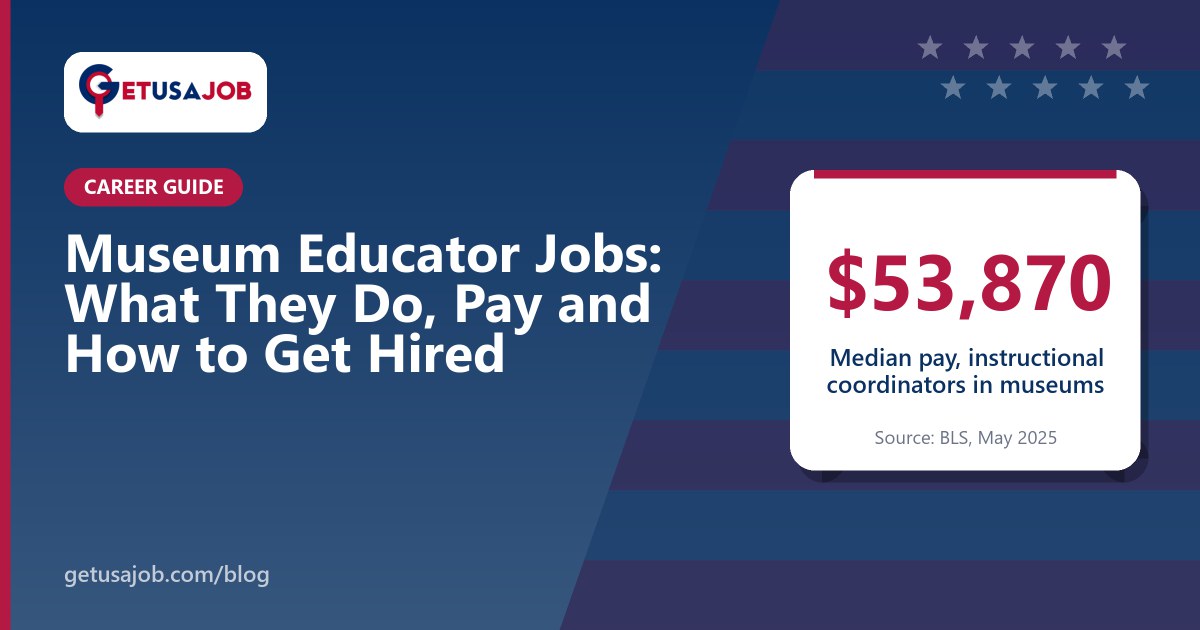
Table of contents
- What does a museum educator do?
- Museum educator job titles
- How much do museum educators make?
- What qualifications do museum educators need?
- A degree in a subject the museum teaches
- Teaching experience
- A museum education or museum studies degree, for some jobs
- Useful extra skills
- How to become a museum educator
- Volunteer, or train as a docent
- Take a paid internship or youth program
- Start part time
- Show your teaching on your resume
- Who hires museum educators?
- Where to find museum educator jobs
- Related guides
Short answer: museum educators teach in museums. They lead school field trips, gallery tours, family days, summer camps, teacher workshops and adult programs, and they write the lessons behind them. Most jobs ask for a bachelor's degree plus teaching experience, and many educators start part time, as interns or as volunteers. Pay is modest: in museums, historical sites and similar institutions, BLS puts the median for instructional coordinators at $53,870 a year and for guides at $16.95 an hour (May 2025).
"Museum education jobs" and "museum educator jobs" are two of the most common searches that bring people to GetUSAJob's museum pages. This guide explains what the work involves, the job titles to look for, what the jobs pay according to the latest federal data, and how people actually get hired.
Key takeaways
- Museum education is a career ladder: educator, then coordinator or manager, then director of education.
- BLS does not track "museum educator" as a job of its own. The closest figures for workers employed by museums (May 2025) run from $35,250 for guides to $81,920 for education administrators.
- Teaching experience matters as much as an art, history or science degree. A museum education master's helps for senior jobs but is not required for most entry roles.
- Part-time educator jobs, paid internships and volunteer programs are the usual ways in.
What does a museum educator do?
A museum educator turns a collection into lessons people can take part in. On a typical day that can mean teaching a class of fourth graders in front of a dinosaur skeleton, running a drop-in art activity for families, training volunteer guides or leading a workshop for local teachers. Behind the scenes, educators write lesson plans and gallery guides, schedule school visits, track how many people each program reaches, and work with curators so that what they teach is accurate.
The audiences vary by museum. Art museums run gallery tours and studio classes. Science centers and natural history museums run demonstrations, labs and camps. Historic sites often use costumed interpretation. Children's museums focus on play-based learning for young children and their caregivers. In all of them, educators spend much of their time on their feet, talking with the public.
Museum educator job titles
Museums use many names for similar jobs, so search for several titles. These are the most common, roughly from entry level to senior:
| Job title | What the job usually involves | Typical level |
|---|---|---|
| Museum educator / gallery teacher | Teaches tours, school programs, camps and family activities in the galleries. Often part time or seasonal at first. | Entry |
| Museum instructor / explainer / interpreter | Similar teaching work. "Explainer" is common at science centers and "interpreter" at historic sites and parks. | Entry |
| School programs coordinator | Books and schedules school visits, works with teachers, trains educators and keeps programs running smoothly. | Early career |
| Docent manager / volunteer coordinator | Recruits, trains and schedules volunteer guides (docents) and keeps their tours up to date. | Mid-level |
| Education manager / manager of school, family or adult programs | Runs one area of programs, supervises educators and manages a budget. | Mid-level |
| Director of education / director of learning and engagement | Leads the education department, sets strategy, raises grant money and reports to museum leadership. | Senior |
Also search for "education assistant", "teen programs coordinator", "access programs coordinator" and "curator of education", a title some museums give their head of education.
How much do museum educators make?
The Bureau of Labor Statistics (BLS) does not publish a separate figure for museum educators. The closest figures come from its Occupational Employment and Wage Statistics (OEWS) for May 2025, the latest available. The first column below is for workers employed by museums, historical sites and similar institutions (a BLS industry group that also includes zoos and botanical gardens). The second is for the same occupation in all industries.
| Closest BLS occupation | Fits these museum jobs | Median in museums | Median, all industries |
|---|---|---|---|
| Tour and travel guides | Gallery guides, explainers, interpreters | $35,250 ($16.95 an hour) | $38,120 ($18.33 an hour) |
| Teachers and instructors, all other | Museum educators, gallery teachers | $44,090 | $66,140 |
| Instructional coordinators | School programs coordinators, education managers | $53,870 ($25.90 an hour) | $77,440 ($37.23 an hour) |
| Archivists, curators and museum workers | For comparison: collections and curatorial staff | $56,840 ($27.33 an hour) | $60,330 ($29.00 an hour) |
| Education administrators, all other | Directors of education | $81,920 ($39.39 an hour) | $95,200 ($45.77 an hour) |
Source: BLS OEWS, May 2025, national estimates and the industry estimates for NAICS 712100. Half of workers earn more than the median and half earn less. BLS does not publish an hourly median for "teachers and instructors, all other".
Two things stand out. First, museums pay less than other employers for the same kind of work: a teacher or instructional coordinator earns noticeably more in a school district or college than in a museum. Second, the museum figures are small samples. BLS counts only about 470 "teachers and instructors, all other" in museums, compared with about 16,080 guides and 1,180 instructional coordinators, so treat the educator figure as a rough guide.
Entry jobs are often hourly. Two museum educator ads on GetUSAJob show what smaller museums offer: Noah Webster House in Connecticut posted $15.69 an hour in September 2024, and Glencairn Museum in Pennsylvania posted $15.00 an hour in July 2024. Pay in big cities is higher, and many states and cities now require a pay range in the ad. Our guide to museum jobs in New York City has examples of posted pay there.
What qualifications do museum educators need?
A degree in a subject the museum teaches
Most educator jobs ask for a bachelor's degree. Art history, history, a science, anthropology or education all fit, depending on the museum. What matters is that you know the subject well enough to answer questions from a curious ten-year-old and a retired professor on the same day.
Teaching experience
Ads for museum educators very often ask for experience teaching children or adults, and it is the part many applicants can't show. Classroom teaching, tutoring, summer camp, after-school programs, coaching and library story times all count. Former schoolteachers often do well in museum education, because they already know how to plan lessons and manage a group.
A museum education or museum studies degree, for some jobs
A master's is not needed for most educator jobs, but it helps for manager and director roles. Specialist programs exist. The George Washington University in Washington, DC, for example, offers a Master of Arts in Teaching in museum education: 33 credits over about 14 months, full time, starting in June, with a supervised placement in area museums of 32 hours a week. Bank Street College of Education in New York also runs a master's program in museum learning and engagement. Museum studies degrees cover education too, alongside collections and management.
Useful extra skills
- A second language, often Spanish, for bilingual tours and family programs.
- Working with people with disabilities, for access programs such as tours for visitors who are blind or have dementia.
- Clearances and first aid. Jobs with children usually need a background check, and camps often want CPR and first aid training.
How to become a museum educator
Volunteer, or train as a docent
Many museums train volunteers to work with the public, and it is the easiest way to see whether you like the work. The Art Institute of Chicago's volunteer program is a good example: it supports the museum's Ryan Learning Center, with volunteers who help K–12 school groups, staff the Art Exchange learning space and talk with visitors in the galleries. New volunteers attend two three-hour foundational trainings, complete online training on safety, working with minors and guest engagement, and shadow a shift. Applications open and close during the year, so check back if they are closed.
Take a paid internship or youth program
Big museums run education internships, and some of them are paid. The Metropolitan Museum of Art says all its internships are paid. Some science centers hire teenagers: at San Francisco's Exploratorium, Explainers are paid youth and adult educators who help visitors use the exhibits, and its High School Explainers program is open to people aged 15 to 21.
Start part time
Many education departments rely on part-time and seasonal educators for school-year field trips and summer camps. These jobs are easier to get than full-time ones, and they often lead to them. If you are a teacher, summer camp jobs at museums are a low-risk way to try the field.
Show your teaching on your resume
Put your teaching experience first, with numbers: how many students or visitors, what ages, how many programs you led. Name any lessons or programs you designed. Our free resume builder makes a clean, ATS-friendly resume in a few minutes.
Who hires museum educators?
Every museum with school visits needs educators, from the largest institutions to small historic houses. Some examples of how big employers organize their education work:
- American Museum of Natural History (New York): employs more than 1,000 staff across scientific research, education, exhibitions, operations and guest services, and only accepts applications for jobs listed on its careers site.
- Field Museum (Chicago): its educator programs include field trips for thousands of students every year, professional development for teachers from pre-K through high school, and the N.W. Harris Learning Collection, which brings objects into classrooms.
- Art Institute of Chicago: its learning work centers on the Ryan Learning Center and K–12 school visits, supported by trained volunteers.
- Exploratorium (San Francisco): its floor educators, the Explainers, are paid, and it runs youth workforce programs for teenagers and young adults.
- Smithsonian Institution (Washington, DC and New York): hires in two ways. Federal jobs are posted on USAJOBS, and trust jobs are posted on its trust careers site.
Children's museums, science centers, zoos, aquariums, botanical gardens, historical societies, university museums and National Park Service sites also hire educators, and they often get fewer applicants than the big city museums.
Where to find museum educator jobs
On GetUSAJob, education roles at museums appear in two places: museum jobs in the USA and education and training jobs in the USA. By city, browse museum jobs in New York, education jobs in New York, museum jobs in Chicago, education jobs in Chicago, museum jobs in San Francisco, museum jobs in Seattle and museum jobs in Portland.
Also check each museum's own careers page, since some education jobs are only posted there, and set up job alerts so you see part-time and seasonal openings quickly.
Related guides
Start with our hub guide on how to get a museum job in the USA. For local markets, read our guides to museum jobs in New York City and museum jobs in Chicago. If you are weighing other museum careers, see how to become a curator or archivist and our guide to art gallery jobs.