Set Design Jobs and Exhibit Design Jobs (2026): Pay, Skills and How to Get Hired
Set designers build the worlds of film, TV and theater; exhibit designers do the same for museums and trade shows. Here is what both jobs involve, what they pay, who hires, and how to build the portfolio that gets you in.
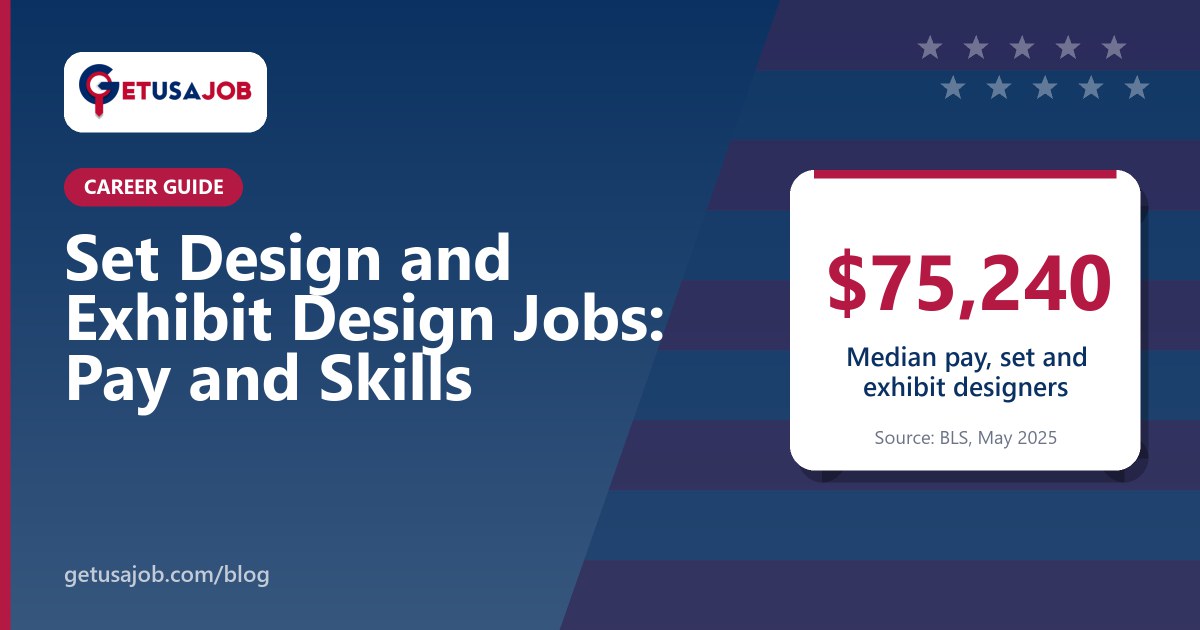
Table of contents
Last reviewed: November 12, 2026. Pay and employment figures come from the U.S. Bureau of Labor Statistics (BLS).
Short answer: set and exhibit designers create the physical spaces for film, television, theater, museums and trade shows. The BLS puts their median pay at $75,240 a year (May 2025), with the top 10% earning more than $135,410. There are about 31,600 jobs nationally and around 2,200 openings a year. Most designers have a bachelor's degree in design, theater or architecture, and two thirds are self-employed, so a strong portfolio and a network of contacts matter more than in most careers.
Key takeaways
- Median pay: $75,240; lowest 10% under $41,750, highest 10% over $135,410 (BLS, May 2025).
- Film and video pays most, with a median of $103,430; theater companies pay a median of $65,050.
- 66% of set and exhibit designers are self-employed.
- Employment is expected to grow just 1% from 2025 to 2035, but about 2,200 openings come up each year as people retire or move on.
What does a set or exhibit designer do?
Set designers (also called scenic or production designers, depending on the industry and seniority) design the scenery for plays, operas, films, TV shows and live events. They read the script, research the period and place, sketch ideas, build scale models or 3D renderings, and work with directors, lighting designers and carpenters until the set is built and working on stage or on camera.
Exhibit designers do similar work for museums, galleries, visitor centers and trade shows. Their job is to turn collections or a brand's message into a space people can walk through: deciding the layout, how visitors move, where objects sit, how text panels and graphics read, and how lighting, cases and interactive elements fit together. In museums they work closely with curators, educators and conservators, who need objects kept safe as well as on display.
Day to day, both jobs combine creative work with a lot of practical problem-solving: budgets, building codes, fire safety, accessibility, deadlines and what can actually be built in the shop.
How much do set and exhibit designers make?
| Group | Median annual pay (May 2025) |
|---|---|
| Set and exhibit designers, motion picture and video industries | $103,430 |
| Set and exhibit designers, all industries | $75,240 |
| Set and exhibit designers, theater companies | $65,050 |
| Art and design workers, all | $58,240 |
| All occupations | $50,980 |
These figures leave out self-employed designers, who make up most of the field and whose income depends on how many projects they win. Freelance theater designers are often paid a fee per production rather than a salary, and fees vary widely from small local theaters to Broadway. In film and TV, union membership matters: many scenic, costume, lighting and sound designers are members of United Scenic Artists Local USA 829, part of IATSE, which negotiates minimum rates and benefits.
Who hires set and exhibit designers?
- Film and TV productions, mostly in Los Angeles, New York, Atlanta and other production centers. These are usually project-based contracts.
- Theaters and opera companies, from regional theaters to touring productions. Larger companies sometimes have staff designers or technical directors.
- Museums, especially larger art, history and science museums with their own exhibitions departments. See our guide on how to get a museum job.
- Exhibit design and fabrication firms, which design and build exhibitions for museums, visitor centers and corporate clients.
- Trade show and event companies, which design booths, brand experiences and stages for conferences and product launches.
- Theme parks, retail and hospitality, which hire designers for attractions, store interiors and themed spaces.
Museum exhibit jobs often appear under titles such as exhibition designer, exhibit designer, exhibit developer, preparator or exhibit fabricator. Searches for museum jobs in Chicago, Seattle and Portland are some of the most popular on GetUSAJob, and our city guides list the big employers in each.
Skills and qualifications
The BLS says set and exhibit designers typically need a bachelor's degree, and some employers prefer a master's degree, especially an MFA in theater design for stage work. Common degree subjects are theater design, interior design, architecture, industrial design and fine art. Employers usually look for:
- Drawing and model making, by hand and in 3D.
- Software: Vectorworks, AutoCAD and SketchUp are standard for drafting; Rhino, Blender or Cinema 4D for 3D visualization; Adobe Photoshop and Illustrator for graphics and presentations.
- Construction knowledge: materials, joinery, rigging basics and what a shop can build on time and on budget.
- Research and storytelling: understanding a period, a place or a collection and turning it into a space.
- Accessibility and safety: museum and public exhibits must follow ADA guidelines, and stages must meet fire and safety rules.
Graphic design skills are a strong plus, especially in exhibit work where text panels, wayfinding and signage are part of the design. Our guide to graphic design jobs covers that side of the work and how AI is changing it.
How to get your first set or exhibit design job
- Build a portfolio from day one. Photograph every model, drawing and finished set or exhibit, and show the process, not just the result. Hiring managers want to see how you think.
- Start as an assistant. Most designers begin as assistant designers, draftspeople, scenic artists, carpenters or exhibit preparators. These jobs teach you how things are actually built.
- Work on small productions. Community theater, student films and small museum projects are the usual training ground and a source of credits.
- Look for internships and fellowships. Many larger museums offer paid internships in exhibition design. In New York, for example, all internships at the Whitney Museum are paid, and some are in exhibition design.
- Read the salary range in the ad. A growing number of states and cities require pay ranges in job ads. Our guide to pay transparency laws by state explains where.
Is it a good career?
It depends on what you want. The work is creative, varied and visible: few jobs let you walk through something you designed with thousands of other people. But it is competitive, growth is slow at 1% over the decade, and most designers work freelance, with uneven income and long hours around opening nights and installation deadlines. Designers who can work across film, theater, museums and events, and who are comfortable with 3D software, tend to find the most steady work.
Find design jobs
Search exhibit jobs, browse art, design and creative jobs and museum jobs, and create a free account to upload your resume and get job alerts. For more guides, see our career guides.
Sources
- U.S. Bureau of Labor Statistics, Occupational Outlook Handbook, "Set and Exhibit Designers" (May 2025 pay, 2025–35 projections)
- U.S. Bureau of Labor Statistics, Occupational Outlook Handbook, "Archivists, Curators, and Museum Workers"
- Whitney Museum of American Art, careers and internships pages